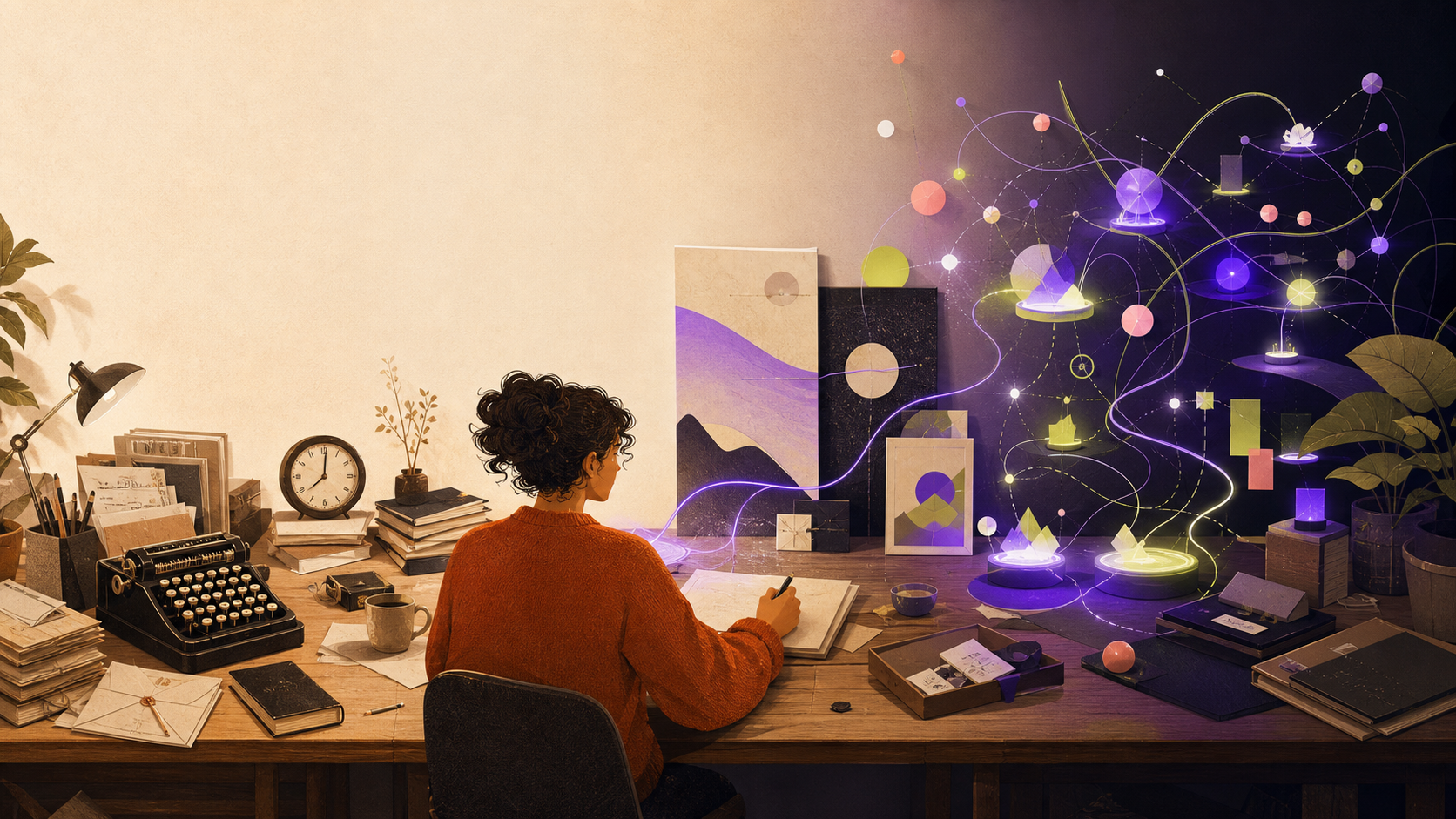
The manual era
Everything passed through human hands.
Every small action had an owner: finding, comparing, copying, checking, sending. The work got done—but people were the connective tissue between every tool.
A day made of many tiny hand-offs
A short story about people, AI & agents
A visual essay about the moment software stopped waiting for the next instruction—and started helping carry the work.
Enter the story↓Scroll slowly. The thread changes shape.
The manual era
Every small action had an owner: finding, comparing, copying, checking, sending. The work got done—but people were the connective tissue between every tool.
A day made of many tiny hand-offs
The software era
Spreadsheets, inboxes, dashboards, tabs. Software made individual steps faster, but someone still had to remember the whole chain—and decide what came next.
Faster actions, fragmented context
The answer era
It could explain, create, translate and transform. A new kind of leverage arrived—one that could meet people in language, not only in interfaces.
Ask a question. Shape an answer.
The action era
Instead of only returning an answer, an agent can break down a goal, use the right tools, report its work, and keep moving through a task with context.
Intent becomes a small, observable loop
The stewardship era
Capability is not the same as permission. The meaningful moment is often the check-in: here are the options, here is the trade-off—what matters most to you?
Autonomy with a visible boundary
The next interface
The future may feel less like operating software—and more like explaining what matters. The tools can carry the motion. We still choose the destination.
A human sets the north star
A tiny agent loop
This is not magic and it is not a real autonomous agent. It is a small, transparent model of the useful pattern: a goal, visible steps, and a human decision at the edge.
Turn a vague curiosity into three useful directions.
A personal working theory
AI can carry more of the motion. People still set the direction, taste the difference, and decide what deserves to exist.
Back to the beginning